WinRAR vs OpenAI: A 30-Year-Old Compression Tool Beat AI Profits
WinRAR has made more cumulative profit (~$300-500M) than OpenAI has ever earned. OpenAI lost $5B in 2024 alone. Here's the absurd financial reality.
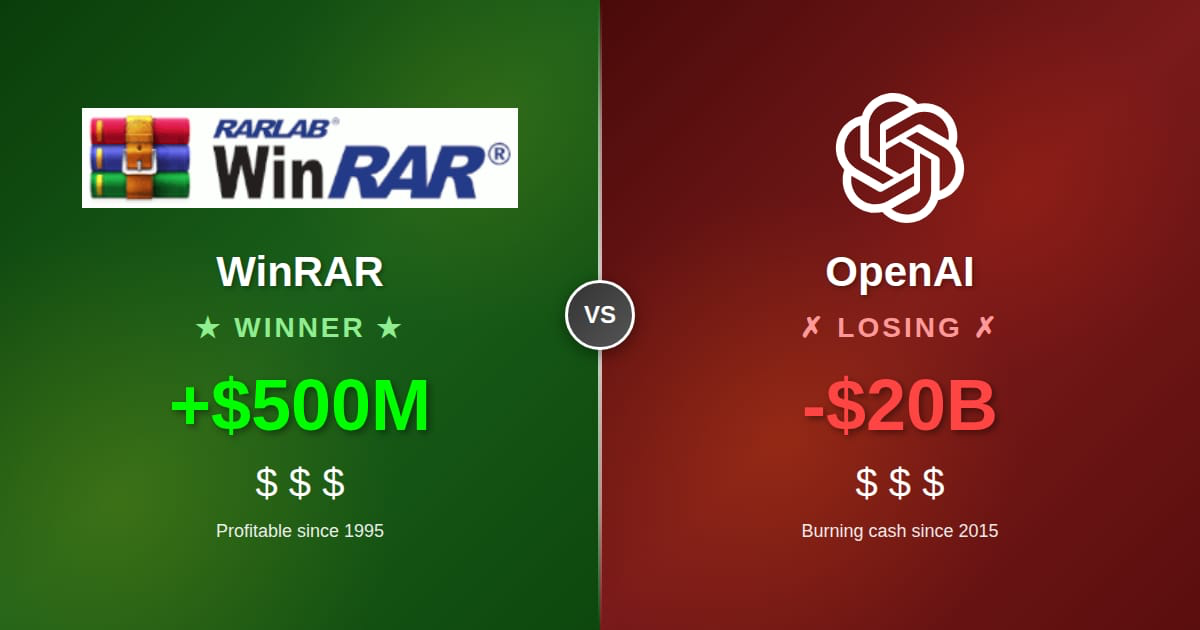
TL;DR – WinRAR, the 30-year-old file compression software with the perpetual "trial expired" popup, has generated an estimated $300-500 million in cumulative profit. OpenAI, valued at hundreds of billions and backed by Microsoft, has accumulated roughly $15-20 billion in losses over its existence. In 2024 alone, OpenAI lost more money than WinRAR has made in three decades.
The Most Absurd Tech Comparison You'll Read Today
Let's start with the most ridiculous fact in tech right now.
WinRAR—the software you've been "evaluating" since the early 2000s—is more profitable than the company that built ChatGPT. Not just slightly more profitable, but astronomically so.
While OpenAI burns through billions to develop frontier AI models, a small German company called win.rar GmbH has been quietly printing money for 30 years with a file compression tool that essentially runs on the honor system. And it's winning.
The Numbers Don't Lie
| Metric | WinRAR | OpenAI |
|---|---|---|
| Years in operation | 30+ years (since 1995) | ~10 years (since 2015) |
| Annual revenue | $15-30M (estimated) | ~$3.7B (2024) / ~$12B (mid-2025) |
| Operating margins | ~60-70% (estimated) | Deeply negative |
| Cumulative profit | ~$300-500M (estimated) | -$15-20B (cumulative losses) |
| 2024 profit/loss | Consistently Profitable | ~$5B loss |
| Business model | "Please pay if you like it" | "Invest now, profit later" |
| Employees | ~50 | 4,000+ |
| Funding raised | $0 | $17.9B+ |
Key Insight: OpenAI lost more money in 2024 alone ($5 billion) than WinRAR has likely earned in its entire 30-year existence. Even with revenue hitting a massive $12 billion run rate in 2025, OpenAI projects an $8 billion operating loss for the year.
WinRAR: The World's Most Successful Guilt-Based Business
Eugene Roshal released WinRAR in April 1995. The premise was simple: a file archiver that handles RAR and ZIP formats. The business model was even simpler: trialware with a 40-day evaluation period.
But as everyone knows, the trial never actually expires.
After 40 days, you get a polite popup asking you to pay. You click "Close," and WinRAR keeps working perfectly. This has been the case for three decades.
And yet, people do pay. Enough that win.rar GmbH has operated profitably for 30 years with:
- No venture capital
- No growth-at-all-costs obsession
- No desperate pivots to AI
- No massive layoffs to please Wall Street
Their revenue comes from consistent license sales to corporations, government agencies, and the occasional individual user who finally feels enough guilt to pay the $29 fee.
The Math on WinRAR's Quiet Fortune
Industry estimates place WinRAR's annual revenue between $15 million and $30 million. With a tiny team of roughly 50 people, no cloud infrastructure costs, and no expensive GPU clusters, their margins are estimated at a healthy 60-70%.
Over 30 years, that adds up to a staggering $300 million to $500 million in cumulative profit. That isn't just revenue—it's actual money in the bank.
OpenAI: The Most Valuable Money Pit in History
On the other side of this comparison, we have OpenAI. Launched in 2015 as a nonprofit, it eventually created a "capped-profit" structure to attract the massive investment needed for modern AI. By 2025, it restructured again into a for-profit public benefit corporation to simplify its multi-billion dollar fundraising.
The Cost of Innovation
According to reports from The Information and Bloomberg:
- 2024 Revenue: ~$3.7 billion
- 2024 Net Loss: ~$5 billion
- 2025 Projections: $12 billion+ in revenue, but with an expected $8 billion operating loss.
- Compute Costs: Running ChatGPT costs hundreds of thousands of dollars per day in server time.
- Talent Costs: Thousands of employees, with top researchers commanding seven-figure packages.
Cumulative Losses: A Running Total
Since its inception, OpenAI has accumulated estimated losses of $15 billion to $20 billion. To put that in perspective: OpenAI has lost roughly 40 times more money than WinRAR has ever made.
For Context
OpenAI's $5 billion loss in 2024 is equivalent to 10x WinRAR's entire lifetime earnings. The AI gold rush is the most expensive gamble in tech history.
Why This Comparison Actually Matters
This isn't just a funny anecdote. WinRAR and OpenAI represent two completely different philosophies of business:
1. Sustainability vs. Scale
WinRAR proved you can build a multi-decade, hundred-million-dollar business by solving one specific problem perfectly and keeping costs low. OpenAI's path assumes that AI will eventually become so essential that they can charge enough to offset tens of billions in debt. It’s a "winner-takes-all" bet.
2. The Power of the "Honor System"
WinRAR's "never-ending trial" shouldn't work in a world of aggressive DRM and subscriptions. Yet it has created a brand so ubiquitous that it’s almost a cultural icon. Trust and utility can be more powerful than forced payments.
3. Efficiency is underrated
WinRAR serves hundreds of millions of users with a team of 50. OpenAI needs 4,000+ people and the world’s largest supercomputers just to maintain its lead. Sometimes, "boring" software is the most efficient wealth generator.
The Irony for the AI Industry
At ShowUpInAI, we track how AI is changing discovery and SEO. The irony is that while OpenAI is reshaping how the world finds information, it still hasn't figured out its own economics.
ChatGPT has 400 million weekly users and is fundamentally changing search behavior. Businesses must optimize for these AI assistants to stay visible. But the platform doing the reshaping is currently a financial black hole.
You don't need to wait for OpenAI to become profitable to benefit from its scale. Your content needs to be discoverable by AI assistants today. Tools like ShowUpInAI help you stay visible in ChatGPT and Perplexity, capturing that traffic regardless of the AI company’s balance sheet.
What Happens Next?
WinRAR will likely keep doing what it's done since 1995: quietly compressing files and generating profit.
OpenAI’s path is a high-stakes race. They must either:
- Reach a massive economy of scale where revenue finally outpaces compute costs.
- Continue raising billions until they achieve AGI (Artificial General Intelligence).
- Be fully absorbed by Microsoft, which has already invested over $13 billion.
The Bottom Line
| WinRAR | OpenAI | |
|---|---|---|
| Total external funding | $0 | $17.9B+ |
| Cumulative profit/loss | +$300-500M | -$15-20B |
| Still here in 30 years? | Already proved it | TBD |
WinRAR’s "perpetual trial" is an internet meme, but the company is the one laughing all the way to the bank. The tool that asks nicely for payment has made more money than the most hyped technology in human history.
Sometimes, boring beats brilliant.
Sources
- WinRAR - Wikipedia – Product history and release data.
- OpenAI - Wikipedia – Financial data and corporate restructuring history.
- The Information – "OpenAI Projects $5 Billion Loss" (September 2024).
- Reuters – "OpenAI expects $5 billion loss on $3.7 billion revenue" (September 2024).
- Bloomberg – "OpenAI's Losses are Growing Fast" (October 2024).
- win.rar GmbH – Official licensing and company information via win-rar.com.
While AI companies figure out their profitability, your content needs to show up in ChatGPT, Copilot, and Perplexity today. ShowUpInAI automates AI visibility so you don't miss the traffic.
Get Started