Is IndexNow Still Important for AI Visibility in 2026?
IndexNow stays essential for AI visibility because AI search depends on fresh indexes, fast recrawls, and reliable discovery across Bing-powered surfaces.

TL;DR - IndexNow became essential for AI visibility when AI search started depending more heavily on fresh, searchable web indexes. That has not changed. If anything, the case is stronger now: AI assistants need current sources, Google still does not offer a general real-time submission protocol for normal pages, and Bing remains one of the most important discovery layers for AI-powered answers.
The Hype Passed. The Need Did Not.
When we first wrote that IndexNow is now essential for AI visibility, the argument was tied to a very specific shift: AI systems were leaning on search indexes, Google had made deep result access harder, and Bing's open indexing ecosystem suddenly mattered a lot more.
That was the immediate story.
This is the longer-term one: IndexNow stays essential because AI visibility is becoming a freshness game.
Not just "did you publish something good?"
More like:
- Did the right discovery systems find it quickly?
- Did they notice when you changed it?
- Is the newest version available when an AI assistant goes looking?
- Can your site handle that process reliably across every important page?
For AI SEO / GEO (Generative AI Optimization), that last question is where most sites quietly lose.
Key Insight: AI search does not reward content that sits around waiting to be found. It rewards content that is discoverable, crawlable, current, and easy for retrieval systems to trust.
Is IndexNow Still Important for AI SEO in 2026?
Yes. IndexNow is still important for AI SEO in 2026 because it gives site owners a direct way to notify Bing-powered discovery systems when important URLs are added, updated, or deleted.
That does not make IndexNow the whole AI visibility strategy. It does make it one of the few practical freshness signals you can control.
If your page is missing from the index, stale in the index, or discovered weeks after a competitor's page, your odds of being cited by AI search systems drop before content quality even gets a chance to matter.
AI Visibility Depends on Fresh Indexes
AI assistants do not magically know your latest product update, pricing change, comparison page, or guide.
They need a retrieval path.
Sometimes that path is a proprietary crawler. Sometimes it is a search partner. Sometimes it is a mix of search results, cached pages, citations, publisher feeds, and direct web access. The details vary by product, query, user setting, and region.
But the practical takeaway is simple: if the systems feeding AI answers do not know about your latest URL, you are not in the answer set.
OpenAI's own documentation says ChatGPT search can turn prompts into web search queries, retrieve relevant results, and answer with links to sources. For Enterprise and Edu workspaces, OpenAI also says search queries may be shared with the Bing search engine to return web results.
That does not mean every ChatGPT answer is "just Bing." It is more nuanced than that.
But it does mean Bing remains a meaningful part of the AI discovery stack. And Bing is exactly where IndexNow gives website owners a direct, automated way to say:
This URL changed. Come look now.
That signal matters.
IndexNow Solves a Different Problem Than Sitemaps
Sitemaps are still useful. You should have one. You should keep lastmod accurate. You should make your site easy to crawl.
But a sitemap is passive.
It says: "Here are my URLs, whenever you get around to checking."
IndexNow is active.
It says: "This specific URL was added, updated, or deleted. Here is the signal right now."
The official IndexNow documentation is clear about the protocol: you can submit one URL by request, or submit up to 10,000 URLs in a single POST. A successful response means the search engine received the URL. Participating search engines also agree to share submitted URLs with other participating engines.
That does not guarantee ranking. Nothing does.
But it does remove a painful delay in the discovery process. For AI visibility, that delay can be expensive.
What IndexNow Actually Gives You
IndexNow is not an AI ranking hack. It is a fast discovery signal. That distinction matters. You still need useful content, crawlable pages, clean internal links, schema where appropriate, and a site that search engines can trust.
Google Still Has No General IndexNow Equivalent
This is where people get stuck.
They hear "AI visibility" and immediately think "Google." Fair enough. Google still matters enormously. You should not ignore it.
But Google's recrawl options are still slower and more constrained for normal website pages. Google Search Central says recrawling after changes can take "a few days to a few weeks". The URL Inspection tool works for a few URLs, but it is manual and quota-limited. Sitemaps help with many URLs, but they are still a discovery hint, not an instant push mechanism.
Google's Indexing API exists, but it is not a general-purpose indexing API for blog posts, landing pages, SaaS pages, ecommerce category pages, or comparison pages. Google says the Indexing API can only be used for pages with JobPosting or BroadcastEvent in a VideoObject.
So if you publish or update content often, the difference is obvious:
- For Google, you mostly make pages easy to discover and wait.
- For Bing-powered surfaces, you can notify the index directly with IndexNow.
That is why IndexNow stays so valuable. It gives you control in the one part of the AI discovery ecosystem where control is actually available.
The Bigger Shift: AI Answers Are Becoming More Source-Sensitive
Early AI answers could feel detached from the web. Ask a question, get a confident paragraph, maybe no citations.
That world is fading.
Users want sources. Publishers want attribution. AI products want fresher answers. Enterprises want auditability. Search-like AI experiences increasingly need to show where an answer came from.
That puts pressure on the retrieval layer.
Freshness becomes a product feature. Citations become part of trust. Outdated pages become liabilities.
If your site has pricing pages, product changelogs, technical docs, comparison pages, local service pages, ecommerce inventory, or timely research, your content can go stale in the index faster than you think.
This is not only a ChatGPT issue. Microsoft Copilot is tightly connected to Bing's search ecosystem, and Perplexity-style answer engines are judged by how quickly they can surface current, citable sources. When those systems need fresh web evidence, fast discovery is part of the game.
Here is the uncomfortable version:
Publishing is not the finish line anymore. Index freshness is part of distribution.
Why Manual IndexNow Does Not Hold Up
You can implement IndexNow yourself.
For one small site, that might be fine. Generate a key, host the key file, submit changed URLs, watch your response codes, avoid over-submitting, and make sure everything still works after your next CMS, hosting, plugin, or framework change.
The problem is not the first setup.
The problem is the hundredth update.
Or the tenth domain.
Or the client site where the sitemap changed format.
Or the Shopify collection that updates inventory without creating a clean "publish" event.
Or the WordPress plugin that stops firing after a migration and nobody notices for six weeks.
That is the part most IndexNow advice skips. It treats the protocol like a checklist item. In practice, IndexNow is an operational system.
If your site changes often, do not think of IndexNow as "submit my homepage once." Think of it as ongoing change detection plus reliable submission.
What You Should Automate
The minimum viable IndexNow setup is simple. The reliable version has more moving parts.
At a minimum, you want:
- Automatic detection of new URLs
- Automatic detection of meaningful content updates
- Submissions for added, changed, and deleted URLs
- A valid hosted key file
- Retry logic when submissions fail
- Logs showing what was submitted and when
- Coverage across every domain you care about
That last point is huge for agencies, affiliate marketers, ecommerce operators, and SaaS teams running multiple microsites or product-led landing pages.
One domain is a task.
Twenty domains is a system.
One hundred domains is where manual processes go to die.
How ShowUpInAI Handles the Boring Part
This is exactly why we built ShowUpInAI around automation instead of another "copy this API request" tutorial.
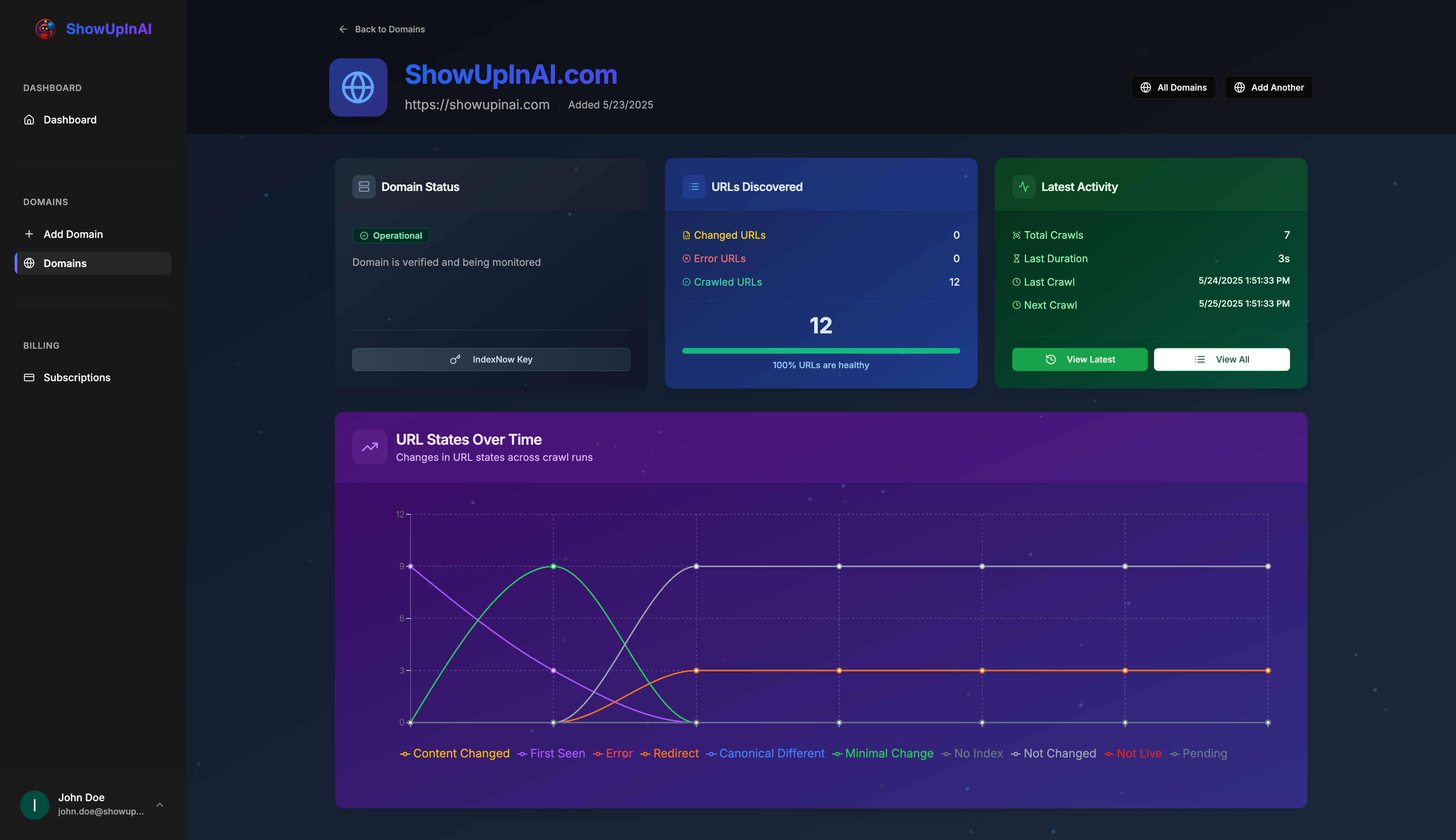
ShowUpInAI crawls your site, detects changes, and submits updated URLs through IndexNow so your content has a faster path into Bing-powered discovery systems.
ShowUpInAI monitors your domains, detects meaningful page changes, and submits updated URLs through IndexNow so your content reaches Bing-powered AI discovery systems faster.
That matters because AI visibility is not a one-and-done setup.
It is a habit your website needs to keep performing in the background.
So, Does IndexNow Still Matter?
Yes. And the reason is more practical than trendy.
IndexNow still matters because:
- AI assistants need fresh web sources.
- Bing remains an important search provider for AI-powered answers.
- Google does not provide a general real-time submission API for ordinary pages.
- Sitemaps are useful, but passive.
- Manual submission does not scale.
- Fast discovery can be the difference between being cited and being invisible.
The first wave of AI SEO was about realizing that AI assistants use the web.
The next wave is about making sure your best pages are discoverable when those systems go looking.
IndexNow is not the whole strategy. But it is one of the few levers you can pull today that directly improves the freshness side of AI discoverability.
That is why it became essential.
And that is why it stays essential.
Sources and Further Reading
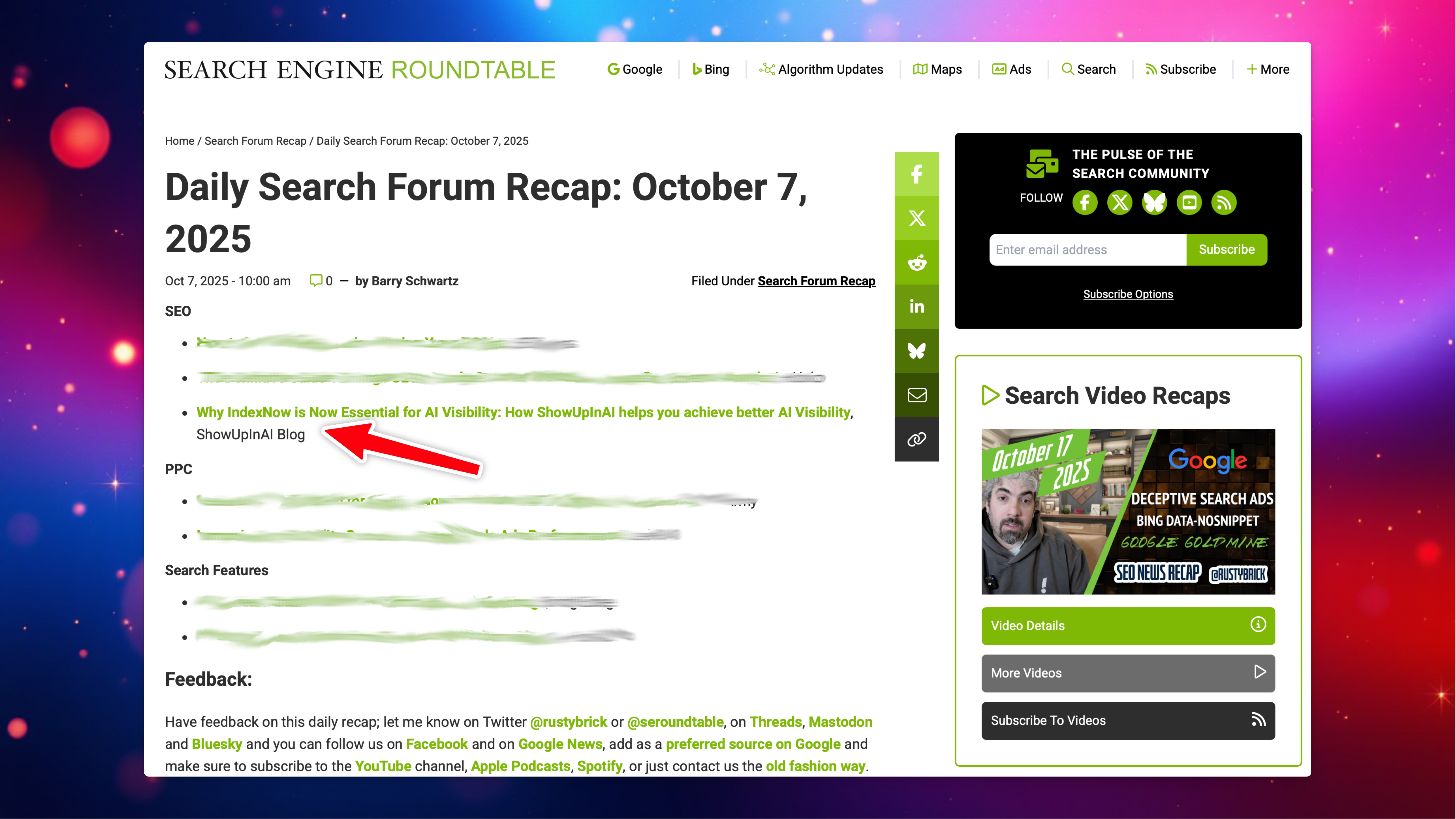
- Why IndexNow is Essential for AI Visibility in 2025
- IndexNow official documentation
- OpenAI: ChatGPT search for Enterprise and Edu
- Google Search Central: Ask Google to recrawl your URLs
- Google Search Central: Indexing API Quickstart
- How to Push Your Pages to Bing for Faster AI Discoverability
Try ShowUpInAI free. Automate IndexNow submissions across your domains, keep Bing updated, and give ChatGPT, Copilot, and Perplexity a faster path to your latest content.
Get Started